Tuesday, January 19, 2016

Do You Have These 21 Essential Relationship Skills? by Dr. Alice Boyes on The Kyle Phoenix Blog

There are a couple of ways you can take this relationship self-test. The first is to just rate yourself. Another is to have your partner/spouse also rate you. That way you'll gain knowledge about any discrepancies between your perception of your behavior and your partner’s view.
Instructions: Rate yourself on each of the following using a 1 to 7 scale, where 1 = Not at all skilled, and 7 = Excellent. (See the notes at the end of the article for tips about interpreting the results.)
How skilled are you at...?
1. Perspective taking? (You’re able to see situations from your partner’s point of view.)
2. Taking an interest in what’s important to your partner? (You take an interest in what your partner has going on in their day, and what they’re feeling excited or nervous about.
3. Smoothing things over with your partner after getting irritable with each other?(You can recover from major or minor arguments in a healthy way.)
4. Expressing love and positive emotions through touch? (You initiate a variety of types of affectionate touch.)
5. Having fun in your relationship? (You laugh and have fun together. You make an effort to do things together that you both find fun.)
6. Picking up on your partner’s cues when they need some TLC? (You notice when your partner needs support, and provide a type of support your partner finds useful/soothing.)
7. Empathizing? (You genuinely care when your partner is going through a tough time.)
8. Expressing love and positive emotions verbally? (You're able to say, "I love you," give compliments, express gratitude, etc.)
9. Providing clear-headed advice when your partner wants your opinion? (When your partner is struggling with a decision, you provide useful thoughts and opinions.)
10. Doing your fair share of joint tasks? (You may not divide every task equally, but overall, the division of labor in your relationship is roughly equal.)
11. Trustworthiness? (You're trustworthy. You show up when you say you're going to show up, and don't blab private or embarrassing information.)
12. Introducing your partner to new, positive experiences? (You introduce your partner to new friends or hobbies, or tell your partner about good TV shows or books.)
13. Boosting your partner's self-esteem in areas in which they lack it? (You help your partner recognize their good qualities that they don't fully recognize.
14. Being their emotional rock? (You're emotionally reliable and your partner can have complete confidence that you're in their corner.)
15. Listening without defensiveness? (You're willing to hear your partner's perspective without jumping straight to defensiveness.)
16. Greeting your partner warmly? (When you say hello or goodbye to them, you do it with emotional warmth.)
17.  Helping your partner get a clear perspective? (If, for example, your partner tends to jump to negative conclusions, you can help them balance out their perspective.)
18. Compromising? (You can bend to want your partner wants, at least sometimes. You're good at finding a middle ground, and you'll take your partner's suggestions.)
19. Being vulnerable? (You're willing to let your partner into your emotional world, by telling them about your thoughts and feelings.)
20. Understanding your partner? (You know what makes your partner tick—their goals, likes, anxieties.)
21. Soothing your own irritability? (You have skills for dealing with feeling stressed or irritable, so that you don't take it out on your partner.)
Notes
  • Whatever your partner’s perspective is, accept that it’s their perspective. Don’t start an argument over whether they’re giving you a “fair” rating. Hopefully you’ll be pleased with how your significant other rates you. If you’re not, you’ve gained some specific feedback you can use to make improvements.
  • Some people naturally give lower or higher ratings on quizzes like this one. If your partner rates you lower than you expected, that might just be their rating style.  
  • Look at the pattern of your partner's ratings as well as the numbers. See if it tracks with how you rated yourself. Did they seem to rate you a point lower than you rated yourself on every item? Were their ratings of your strengths and weaknesses the same as yours (e.g., you each gave you the highest rating for being fun)?
Author
Source: Author
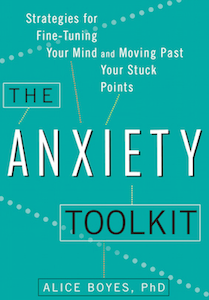
Dr Alice Boyes is author of The Anxiety Toolkit(link is external) (Perigee/Penguin Random House, 2015).
Subscribe to her blog articles (link is external)and receive the first chapter of the book free. 
Twitter: @DrAliceBoyes

What are some things that hold people back from being successful? by Rebecca Massey on The Kyle Phoenix Blog

When I quit full-time work to spend more time writing, the number one thing people told me was "That's awesome!" The number two thing -- and it was a very close second: “I could never do something like that,” and its common variant, “I want to do something like that, but...”
Not very long ago — less than two years ago — I never could have done something like this, either. What changed? What made the difference?
My Powerball winnings! Just kidding. I have no such thing. And some people would hit the Powerball and STILL not do whatever it is their heart is crying out for them to do. You wanna know why?
The problem isn’t money, or know-how, or knowledge, and for most people, it also isn’t time. The problem is fear.
Fear that you’ll fail. Fear that everyone will think you’re stupid or crazy. Fear that you’ll end up broke and homeless. Fear of the difficulty and suffering that may or will come along the way. Fear that what you do won’t mean anything or have any value to anyone. Fear that you’re not good enough, that what you’ll do is in fact not even worth your own time. Fear that you’ll end up on a one-way trip away from the life you have now and you’ll never be able to go back to anything like it. Fear that it’s too late and you’re too far behind to even start. Fear that no matter how hard you try, it will all have been for nothing.
That’s what’s keeping you still. That’s what’s holding you back. Whatever it is that you want to be doing, the reason you aren’t doing it isn’t that you’re broke, busy, or anything else. It’s because you’re afraid.
THIS IS NORMAL. Everyone has these fears. Everyone. Think of all the most fearless go-getters you know. Maybe one or two of them are sociopaths and actually lack fear. The rest? They’re scared. They might be really good at making sure you never see ’em sweat, but something is scaring the crap out of them. I guarantee it.
The difference is that at some point, they decided they were going to do something about the fear, and then they did it — whatever they needed to do to live with the fear, to move through it, and to take action anyway.
Sometimes, something happens to give you a hard push toward making that decision. Very often, nothing happens at all, and you have the additional challenge of drawing out the motivation and the reason from within yourself. (And the fear that those, too, aren’t legitimate or good enough.)
It’s easy to get caught up in thinking that you have a million things to do before you can even start. This is wrong. Flat out wrong. Dead wrong. You don’t have a million things to do. You have one: Face your fear, and figure out how you’re dealing with it.
“Yeah, okay, great,” you’re thinking. “HOW do I face the fear?”
Challenge accepted. Let’s work through the list from above. It is by no means complete or comprehensive for all possible fears of all people, but I think at least one of them applies to everyone (self included).
  • Fear that you’ll fail. You might fail. It’s true. You could do 100% of everything perfectly right and there’s still no guarantee that you will succeed. There are usually two assumptions that feed into the fear of failure. One is the idea that failure is automatically a fault. The fault isn’t in the failure itself — it’s in not trying to succeed or improve. If you legitimately gave it your best shot and you failed, then perhaps you failed at your goal, but you will have succeeded in dozens of other ways: new skills learned, new connections made, new experiences lived, new things discovered about yourself and what you’re capable of, and if nothing else, the peace of mind that comes from erasing a “what if?” from your life. If you didn’t work at it and you didn’t try and you sat around waiting for success to happen, and you failed? Then, and only then, is when the failure is all you have. The other assumption is that people tend to think about success and failure in all-or-nothing, hyper-idealized-or-catastrophic terms. Either you’ll be a new Richard Branson overnight, or you’ll lose everything and everyone you ever had and you’ll die in a box under a bridge while everyone points and laughs and talks  about what a moron you were to think it’d happen any other way. Neither of these things are going to happen. It may be the case that you’re middling and muddling for a while, not really succeeding or failing. But if you’re happier doing that than doing what you’re doing now, and if good new things (any good new things, not just money) come into your life along the way, how on earth could it be “failing?”
  • Fear that everyone will think you’re stupid or crazy. Some people WILL think you’re stupid or crazy — even if you’re a wild success — and it will hurt. There’s no avoiding it. However, you WILL ALSO be stunned at how many people already think that you’re smart and awesome and that what you want to do is totally great and that you should do it right now. Even total strangers! Find those people and keep them close. They will outweigh the naysayers. If you really don’t know anyone in person, hit the Internet and look for groups of people trying to do what you’re doing. (There are also plenty of groups for people thinking “I don’t know what I want, but it’s not this.” The ‘net is magic like that.) Get rid of the people keeping you down, if you can, or else minimize your exposure to them. If the people you live with are the ones keeping you down — parents, guardians, significant others, or roommates — this is unfortunately going to be a long-game situation for you until you (hopefully) can move on to a more supportive setting. In the meantime, do not hesitate to lean on the people who are cheering for you. They will help you keep your eye on the prize.
  • Fear that you’ll end up broke and homeless. A word that comes up a lot in these discussions is “safe,” and when people use that word, it's usually code for this fear. A lot of people are under crushing debt. A lot of people don’t have any savings to fall back on. A lot of people are taking care of kids, elderly parents, or both. Deviating from the path they’re already on is the last thing from “safe.” The good news is that there are a whole range of things you can do to increase the margin of safety. Increased safety does usually mean decreased speed of accomplishment, but slower still beats nothing. Figure out the compromise that works best for your situation, and then plan accordingly: keep doing what you’re doing now, but also carve out some time every day for working on your new goal; reduce expenses so you can spend less time in the old thing and more time in the new thing; or start saving money so that later on you can quit the old thing and jump in whole hog on the new thing. I went with the second option — I moved someplace cheaper to live, and I stay in the day job part-time.
  • Fear of the difficulty and suffering that may or will come along the way. Let me tell you, now that I live Out Yonder, I really miss my friends back in the big city where I used to live. I used to be able to call or text or IM somebody and say “Hey, wanna hang out this weekend/tomorrow/right now?”, or they could contact me about the same thing with the same amount of notice, and it would almost certainly happen. Now, that's got to be planned way in advance, and somebody’s gonna be in a car for hours to make it happen, so it doesn’t happen a whole lot. It sucks. I’m also enough of a hedonist to admit that I miss having all the big city entertainment and dining options at my fingertips; now, if I want something interesting to eat or to do, I generally have to come up with it myself. That sucks too. But you know what really sucks? Getting up and grinding through another day in a robot’s life, with the occasional guilty fantasy about what it might be like to do it differently. And you know what’s really awesome? Not living like that anymore. So if you’re worried about any hardship that might come with the changes you need to make in your life, ask yourself this: Are you not alreadyexperiencing hardship by ignoring what you really want to be doing, waking up each day knowing that you won’t be doing that thing today, talking yourself out of it whenever you feel your mind or heart calling?
  • Fear that what you do won’t mean anything or have any value to anyone. The funny thing about meaning and value to others is that it really isn’t your call — it’s up to other people. You cannot force what you do to be meaningful to others (not even charity work); all you can do is try your best to connect your work to the people who are most likely to find it meaningful, and let them feel what they will about it. The flip side? If it’s meaningful and fulfilling to YOU, it is almost impossible that it will not be valuable to anyone else, if for no other reason than that happiness is infectious — when people see it, they want it, and they’re attracted to it. Also, think of the most banal garbage you can imagine. Think of your least favorite bit of irredeemable pop culture schlock. Someone out there will tell you they owe their sanity, happiness, or direction in life to it. There is plenty of room for you to add to the world. Even if it’s your own irredeemable pop culture schlock.
  • Fear that you’re not good enough, that what you’ll do is in fact not even worth your own time. All of us doubt that we’re good enough and that what we’re doing is good enough. Okay, again, maybe one or two people you know are nuts and genuinely believe that they’re awesome all the time. The rest, again, are feeling the fear and doing it anyway — trying even though they know it might not be (or probably won’t be!) good enough. Again, find the people who have your back, cheer you on, teach you, inspire you, or make you think -- even if you don't believe them. The little doubting voice never goes away. But your people will help you remember that the voice is only telling the worst version of the story. Everything you do is a step toward the next thing you’re going to do. Even if the first twenty thousand steps land in mud, keep your head about you and keep walking toward the good places and you will get there. That other people got there faster, or are already there, doesn’t mean you can’t or won’t.
  • Fear that you’ll end up on a one-way trip away from the life you have now and you’ll never be able to go back to anything like it. It is almost certainly true that you won’t be able to just hit the rewind button and go right back to where you started. Depending on what your particular situation is, it may also be true that you really will never be able to get back into the a similar situation; e.g., certain careers that demand their practitioners follow a specific and exact path, and don’t tolerate any deviance from that path. I’d be lying if I told you that no door closes permanently; it’s very, very hard to watch that happen. But the new doors to open are the things to consider. You wouldn’t have read this far if you were happy with the life you have now.
  • Fear that it’s too late and you’re too far behind to even start. It’s never too late to have a happy ending. And there isn’t a cap on the number of happy endings to go around. You’re older than most of the people doing what you’re doing? Good, you're ahead on dealing with life things and learning about yourself like the younger folks are still busy doing. The field is saturated? You’re going to have to be more persistent and more creative about how you’re going to get in — maybe a LOT more persistent and creative — but it’s impossible that there isn’t room for one more. The thing you’re good at or passionate about is yesterday’s big thing, not today’s? Okay, you missed the hype boat and maybe missed the big *money boat, but there’s a community of people who are still REALLY into yesterday’s thing out there somewhere — and thanks to the internet, it’s easier than ever to find them. Or, you can find a new thing that builds on what you already know and love.
  • Fear that no matter how hard you try, it will all have been for nothing. If you actually do try, this is genuinely impossible. Your new endeavor may crash, burn, and explode, but you’ll be in a new place in your life, with new things to build forward from, and new people to help you do it.
Once again, this article isn't about having the solution to all possible problems. But there is one problem that’s really holding you back: Fear.
Move through the fear, and you will be shocked — in a good way — at all the good things that happen next.
I promise.

Friday, December 11, 2015

When and Why Bad Sex Happens To Good Men by Kyle Phoenix

You're at Screwing Time (leaped right in, didn't I?) perhaps there's no love involved.  In fact let's make it our example that you're not in love, you're just two guys who like each other's rubber parts.  You've met online or in person and now you're at say, his house and the energy is there, the groove is there, the passion is present.

You have an erection; he has an erection.

You start kissing.  His tongue is everywhere.
No, everywhere and not in a good way.
He's licking your face.
Then he starts to finger you, through your pants.
No, wait that's not a finger, that's damn near his whole hand.
Not like in a passionate fisting, well lubed hand way, more like in a "Is he looking for his ATM card?" way.
He's doing too much.
He's trying too much.
You gently move his hand away before he ruins your pants and you hold his face a little, to try to slow him down.
He's fine so you let it go further.

You're naked.

He's really humping your leg.  Aggressively.
Now he's chewing on your nipples.
No, really chewing, like steak chewing.
He's back to the hand fucking again.
You're afraid to top him or bottom for him.
Oh God, he's diving towards your crotch with his mouth wide open!

You're stuck in a bad sex scenario where passion, pleasure and pain are not balanced, like a stereo.

Passion is the feeling, the erotic excitement you feel for someone.  You don't have to know them well to feel these feelings, it's chemical and historical.  Chemical in the sense that you are turned on by them.  It's historical in the sense that a whole bevy of impressions and feelings and images and past sexual encounters are all balled up and coming to the unconscious forefront.  Think of it like your underground pipeline into your sexuality.  Not all of it is conscious but it is fuel.

Pleasure is both historic and situational.  You have a history of things that turn you on, that you like, which is probably part of what got you to meeting this gentleman in the first place.  He's your "type".  He meets your preferences.  Some of that is hopefully fluidic.  By that I mean if you like slim guys (because of that crush on your slim dad or slim guy in high school), you haven't gotten obsessive about it and query guys on if they're exactly 155lbs..  You may be comfortable with a guy who is ten or twenty pounds heavier because you accept that there are other dynamics that fuel your interest and attractions now.

You've been dating this gentleman for awhile, the lights are low, the music is playing---the situation has a romantic, erotic air to it that is fueling a deeper eroticism for you.


Pain.  

Pain comes in many forms, including erotic pain.  Frustration, tension, intensity, doubt---are all forms of emotional pain.  Pinching, slapping, pulling---are all forms of physical pain.  Both sets done in controlled degrees can be wonderful to experience when you and a partner can agree to your needed degree.  It's when we don't have control on the degree that we enter the realm of bad sex.  But the constant crossing of that boundary, that degree is what makes it uncomfortable, painful in a negative way.

Okay, then, how to negotiate bad sex to better sex, especially if you really like him?  It helps if you can figure out who is the Alpha and who is the Beta.


            As you can see from the brief descriptions, an Alpha might frame sex in much more binary ways while a Beta might experience sex more associated to his emotional self and internal desires.  This is crucial to understanding why Tops, Bottoms and Versatiles sometimes have trouble negotiating  what will occur, what has occurred, what they want and why.  My book---Good Men for Men focuses more on the physical pleasuring aspects of sex thatshould lead to emotional satisfaction but it is important that you’re clearwhat context (fun, experimental, dating, long term relationship) you’re havingsex in.  Be clear with yourself.  Try to be clear to sexual partners.  And most importantly experiment; try newthings and positions because there are dozens of ways to enjoy yourself thatyou may have.


You are a man who enjoys having sex with men.  
You’re a Top or maybe you're a Bottom or maybe you're rocking being Versatile and that's wonderful.  
You've been sexual for awhile and you've started to find that there's a common thread through the men you're having relations with.  
The Bottoms seem emotionally crazy and the Tops seem detached from anything but the sexual act….and the Versatiles tend to be more balanced.  
Why is that?  
This is both normal and a condition related to your sexuality or more importantly, it’s a condition related to the genders/sexes involved in your sexuality.  
You want to become more successful as a lover, you want to have more pleasure for yourself and you also want to bring more pleasure to your partner.   First you need to understand some distinct definitions so that when communicating with your sexual partners you can be clear on what is teh act of sex, the physicality of their sex, the gender (emotional/social) feelings and perceptions they have/want and how they articulate they sexuality.

Definitions

Sex is one’s physicality.  One can be a male sex, female sex or even intersex.  One can decide that they internally don’t feel like the external manifestation of their body, and that would make them a transsexual.

Gender is how one is socialized by parents and society.  You were socially raised male or female.  That’s being engendered.  That engendering assists humans in acting masculine or feminine.  Our bodies sex isn’t always how we socially or personality act.

Sexuality is what you do with your body.  A person can be homosexual, bisexual, heterosexual, pansexual or even omnisexual.  In Westernized cultures there has been a very narrow bandwidth for expression of sexuality for thousands of years.  All of these sexualities have existed but haven’t always been socially acceptable to express or medically possible to achieve.


A man, who is biologically born the male SEX may present as more GENDER fluid---perhaps in not being overly masculine, even a little feminine but that doesn't mean that his SEXUALITY isn't same gender loving in it's intentions and desires.  I often teach MSM in my workshops that big burly men, skinny, waifish men, chubby nerdy guys and suave cool dudes, may all want to bottom, to have a man directly and deeply penetrate them with his fingers, penis or objects but they may all want the same thing in different things, from a different energy perspective.

The big burly guy, in spite of being 350lbs, wants to be swept up and passionately but gently made love to----kind of like Scarlett O'Hara before he goes back to his job as a Corrections Officer.

The skinny waif wants a hardcore bondage scene of force-play that involves lots of nipple toture while he's being penetrated with everything in his drawers, your drawers and the kitchen sink.

The chubby nerdy guy wants slightly vanilla casual sex that is quick on penetration but lingers on oral sex because while he mentally likes the idea of being penetrated, he can't stand the discomfort and the sense of vulnerability with someone he's not in a long term relationship with.

The suave, cool dude wants to give directions and commands and feedback and is excessively verbal about busting out his "manpussy" because in his mind/world that's what a power bottom does.

All bottoms.  All day long.  But their intersection of Sex, Gender and Sexuality are variables that a good sexual partner, even just a casual hook up will have to listen astutely to.  But how do you get to this point.  You ASK.

What do you like?
Get as specific as possible BEFORE sex.
You need to know from the skinny waif to bring extra lube, wash your dildoes and lock the dog up in the other room so he doesn't think the screams are those from murder.
You might also, as the Top or Versatile (or if you're the Bottom, letting the other know) what you can and cannot accomplish.  Big burly needs to understand that your Gone with the Wind fantasy needs a third, Jenny Craig before you can fulfill his internal gender/sexuality fantasy.  He might see you as a tall, dark stranger but gravity and girth see him, your back, and your capabilities in a whole different fashion.

You may also need the space to express to all of the above gentleman what your sexuality looks and feels like for you.  Perhaps you don't want to be the dominate principle/person all the time or the dungeon master of the teacher or the thoroughly used Top (or Bottom.)  The crime of the context of Dominant and Submissive, Top and Bottom sort of puts men in a trap before they can express who they are and be heard for what they enjoy and don't, or even learn it.  If I say I'm a Top the skinny S&M guy may think I get off putting ever larger objects into him or the power bottom thinks I'll like being ordered around if he just breaks me in.  All this has to be negotiated.

When two men get together beyond simply the physicality there is also an emotional and spiritual component and it behooves men who want to have both good lovers and be good lovers to take a moment, and listen, try to intuit and ask where the other person is.  

Let's apply the Chinese concept of chi energy or even more in-depthly, yin and yang, and to the kinds of men you might encounter or might be yourself.  You’ve probably noticed that there are Alpha men (more masculine because of heavier testosterone production in their bodies) and then there are Beta males (due to heavier levels of estrogen production in their bodies).  Alphas being Yang, the masculine principle, mostly Tops, sometimes Versatile and Betas, being Yin, the feminine principle, more so Versatile or mainly Bottoms.  From researching thousands of homosexual men, 15% of homosexual men are Alphas and 85% of homosexual men are Betas.  This is the main reason why there seems to be an overabundance of Bottoms.  

Biologically speaking, there are more Betas, men with higher estrogen on the planet, period.  Scientists believe this comes from Nature's balancing of warriors for protection of the herd being Alphas but Betas being available to parent and not be threatened by their offspring and other males so immediately.  Betas don't have the need to dominate with their energy and sexuality as much as Alphas do.  However as an same gender loving man you might find that what you like to do, your energy, how you appear (from testosterone and estrogen) are vastly different than how men perceive you.  In this respect, men and women have it much easier in that their bodies and socialization suggests who will be the dominant principle (even though this can be different even with opposite sexes.)

Confusing I know.  But once you sit down, take the Alpha Beta test yourself and identify yourself you then become a mini-expert on identifying others and understanding why it works with some men and doesn't with others.  

Homosexual men desperately want to be testosterone laden manly men Alphas.  Desperately.  Biologically most aren’t.  In fact the same statistics roughly hold for heterosexual men as well.  This intense desire to be an Alpha male goes all the way back to social issues, masculinity obsession, manhood issues and inadequacies, Mommy and Daddy issues, and intimacy issues.  That’s a lot to explore and unpack and I’ll probably do so in future works.  This text though is for the rest of you who are mature enough to accept Nature and want to know how to be happy with who and what you are and like being.

You're going to have to embrace your sexuality on another level, a level that includes, looking clearly at your own sexuality and what is both psychological and biological.  By embracing both.  By recognizing that your sexuality, even if it's not heterosexual, is natural, through biology, you're then able to embrace and explore it.  Bad sex stems from a lack of communication with other men as well as yourself.  Answer that and you'll never have bad sex again.

Once we embrace our Sexuality, personally, spiritually, biologically, we're then able to discuss, answer and question with others about what we feel in a Gender concept of ourselves and in a Sex framework of what we want to do with our bodies.  The beauty of same gender loving sex is the amount of variety available.

Good sex(ing) happens when I ask you what you like and YOU KNOW.
And you ask me and I KNOW.

Bad sex happens when I ask you and your answers are only the mechanics of sex ("Stick it in!"  "I like to suck da dick."  "Body contact." ) rather than the diversity that we saw above in the examples.

Take your time.  Talk to men,  Get a little library of relationship and illustrative texts and videos on sexuality together.  Not just porno.  Sex and sexuality shown through the lens of acceptability, interest in a partner's satisfaction and honesty about what each likes.  I guarantee you that from the workshops I've taught sex lives improve 1000%!


Enjoy!!!
Thank you for reading.
Email: kylephoenixshow1@gmail.com
Website: http://kylephoenix.com/
Blog: http://kylephoenixshow.blogspot.com/2012
Thanks and enjoy!


You can Like Us on Facebook or Follow Us on Twitter!


Don't forget to watch The Kyle Phoenix Show on


Channel 56 (Time Warner), 83 (RCN), 34 (Verizon)


simulcast on MNN.org and http://kylephoenix.com/.


All books by Kyle Phoenix are available through Amazon.com and Barnes & Noble.


Sign up for the mailing list on my website (I’ll never share your information with a 3rd party) and you’ll receive the E newsletter and alerts about new products, books, and Special Reports.


Copyright © The Omni Group, Inc , 2015

Kyle Phoenix, 2015


Manhattan, New York