Showing posts with label financial education. Show all posts

Monday, July 9, 2018

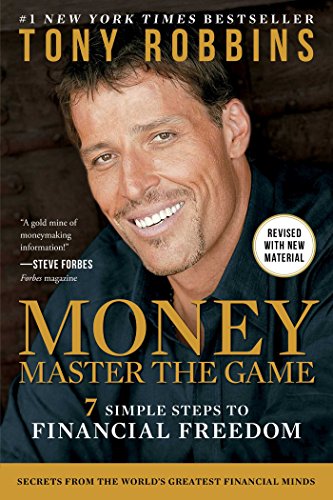
Kyle Phoenix Liberation List (book): Money by Tony Robbins


1476757860

In his first book in two decades, Anthony Robbins turns to the topic that vexes us all: How to secure financial freedom for ourselves and for our families. “If there were a Pulitzer Prize for investment books, this one would win, hands down” (Forbes.com).Tony Robbins is one of the most revered writers and thinkers of our time. People from all over the world—from the disadvantaged to the well-heeled, from twenty-somethings to retirees—credit him for giving them the inspiration and the tools for transforming their lives. From diet and fitness, to business and leadership, to relationships and self-respect, Tony Robbins’s books have changed people in profound and lasting ways. Now, for the first time, he has assembled an invaluable “distillation of just about every good personal finance idea of the last forty years” (The New York Times).Based on extensive research and interviews with some of the most legendary investors at work today (John Bogle, Warren Buffett, Paul Tudor Jones, Ray Dalio, Carl Icahn, and many others), Tony Robbins has created a 7-step blueprint for securing financial freedom. With advice about taking control of your financial decisions, to setting up a savings and investing plan, to destroying myths about what it takes to save and invest, to setting up a “lifetime income plan,” the book brims with advice and practices for making the financial game not only winnable—but providing financial freedom for the rest of your life. “Put MONEY on your short list of new books to read…It’s that good” (Marketwatch.com).

Smile, Kyle
KylePhoenixShow@Gmail.com


You can Like or; Follow Us on Facebook or;Twitter

Or Click Below to:
·                     Kyle Phoenix Website
·                     The Kyle Phoenix Blog
·                     Check out Kyle Phoenix Products on Amazon .com


Sunday, January 19, 2014

My Art and Success, Part 2: Money, Business and People by Kyle Phoenix


I've written here about my entrepreneurial work over the past 25 years since I was 7 (and gotten lots of fun, insightful, helpful, questioning and complimentary emails about it!  Thank you) and more requests to expand on what I've learned and hope to accomplish.  I'm loathe to do a complete business breakdown because the numbers aren't where I want them to be, but I am supported by the fact that there's a line you cross as a Creator where you're never quite satisfied with just the number anymore, it's just a number, a way of keeping score.  To that end today's total holdings for me, as an exercise, Kyle Phoenix total $265,000,000 roughly, give or take some interest and shifting securities.....on the Hollywood Stock Exchange.

Following Robert Kiyosaki's advice to play at the game of money and change my emotional connection to it I joined, HSX.com about 14 years ago probably sitting at a temp job.  The premise is simple---movies, actors, actresses, awards, music and musicians, television series, etc. are all converted into securities like stocks on the New York Stock Exchange.  They're assigned a price and you start trading away.  You're fronted $2 million to enter the game and you can do what you want with it, spend it as you like.  Yes, there are billionaires in the HSX Universe, even some having sold their passwords on Ebay to relinquish their accounts.

Occasionally I boot up SimCity on my computer and for one madcap week I go development crazy.  Even more occasionally I'll wander into a video arcade or stop by a machine at a movie theater and play.  I've considered getting an XBox or a PS3 but it's just a lot to sort out, you know?  Besides the kinds of games I like, chess and such mainly focus around business, not killing or simulating killing, and strategy.

I don't consistently focus on HSX, sometimes disappearing from regular check ins and action for months at a time.  But when I do, I can invariably turn it to profit pretty fast, huge profits in a short span of time and huge profits if I really focus.  This begs the next logical question: have I learned anything for the romp into trading securities and have I applied it into the "real world"---yes and yes.  And the million dollar question---have I made any money with said learning and application, a resounding yes!  I even use it in adult education classes as an intensive teaching tool around math skills and understanding money.


The beauty of this is between this game and my own financial education pursuits, I've learned a ton about money and business management and expanded concerns in the financial universe.  Sometimes I listen to friends and family talk about issues---financial crisis's---from a place of unknowing and I realize how out of touch we are in many ways with the fabric of how society has been designed.  Or God forbid I try to have a Facebook discussion and use some terms like fiat currency---it has gotten near apocalyptic with some of the responses because, and I think I hate this as a teacher, it goes above people's heads.  Part of my vision of freeing my people is that so much shouldn't go above our heads, so much shouldn't be re-posited in so few that the mass of people of color are not benefiting.

Slowly, like a patient tortoise I've been designing my "real world" business, figuring out what could be revenue bearing, working to create quality work that could make a little scratch in the marketplace.  More importantly finding the niches where I could learn and direct my abilities.  I've gotten better at choosing my company---joining networking groups, meeting people and friends in a wide variety of business endeavors through school.  School is a hotbed of entrepreneurial push---even if it's not quite termed that way in most people's thinking but maybe it's the mindset, to be able to think and explore that is the push and that pushing gears people to be more entrepreneurial.  Don't get me wrong I don't think college is the only space for such a push because I started out doing things on the side almost 15 years before I became a college student.  But I think college does set you up for the Big Money.

At first Kiyosaki's written assertions and suggestion that the poor were far more greedy than the rich bristled because I want to champion social justice emotionally.  But then when I looked at it emotionally and spent some time listening to people around me---I realized how obsessed with getting and consuming poor people were.  I think that capitalism suggests three states of being---Product, Consumer and Creator/Owner---but because it is a morally neutral system it doesn't educate those who don't seek education.  But it still allows their participation or more normally, exploitation.  I find that I understand a great many things that I don't agree with however I generally diverge that I don't believe in screaming that its wrong without concerted effort to change it or introspection as to my own complicity to it.

I'm getting to the point, I always knew that I would, where I have to consider how to implement my social consciousness about society into my business practices.  I have to consider who makes my products, who I do business with, where and whom I accept money from.  And the point of business is of course, profit so you're always weighing what to do and what not to do---what the line is.


Because as the Hollywood Stock Exchange examples, I'm practicing and thinking and operating my conscious for terms of big money---because even if my businesses attain just a tenth of what I've been able to do in fantasy....well, I'll be ok, right?

Thank you for reading and if you liked this check out the other blogs or one my books on Amazon.com
Kyle Phoenix
Email: kylephoenixshow@gmail.com
Website: http://kylephoenix.com/
Blog: http://kylephoenixshow.blogspot.com/
Amazon.com: simply type in Kyle Phoenix for over 25 paperback and digital books!
Thanks and enjoy! You can Like Us on Facebook or Follow Us on Twitter!
Don't forget to watch The Kyle Phoenix Show on Channel 56 (Time Warner), 83 (RCN), 34 (Verizon) and the Thursday/Friday 12am/midnight simulcast


Saturday, January 11, 2014

I Know What Money Is, My Financial Education, Part 2 by Kyle Phoenix


The most money I've ever made in a week was about $26,000.  Previous to that it had been about $12,000 in 4 hours.  Before I was 21 the best I'd done was about $1,000 in a week.  These three examples come from three different systems, two of them choices and one a non-choice.

The first, the $26K was from entrepreneurial effort and opening a bookstore online.  I'd been muddling over what to do to not only earn more money but to do something else besides just working at a job and I circled back around to the thousands of books surrounding me in my living room.  In the fall I'd been to a Rich Dad, Robert Kiyosaki workshop, gotten inspired and hunkered down to try out my newest entrepreneurial venture.  Eight months later $26, 000 was in my bank account and another $14,000 rolled in in the following weeks.


The second, $12,000 came from following Kiyosaki's advice and taking control of my taxes.  I took the H&R Block Tax class, to understand my taxes in 1998.  I focused diligently in class,only missing two I think---but I was there like a fire cracker for the entrepreneurial section.  I passed the class with the knowledge and never became a tax preparer because honestly I figured out whatever their payment structure was, I could make more focusing elsewhere.  About 3 years later with diligent care and attention to my expenditures and budget, slowly maturing a small business and keeping impeccable records I sat down at H&R Block and mapped out my taxes like a boss and impressed the hell out of my former teachers....and got back $12,000 that year.  Technically, I guess I was right, I'd used the class to make more than possible sitting their doing people's taxes and the subsequent years have been equally well managed.

The $1,000 comes from a job I had as a sales associate at A&S Department store in Manhattan, NY.  We were on commission plus $7 an hour, 8% of every sale I believe.  I was hired in August and by December was rocking a great check from selling literally any and everything in that store.


My personal financial education has been choppy because as much as I understand money and finance and investments and have been schooled (tax prep, financial planning, MBA, and years working as a financial analyst and securities paralegal) my relationship to money took time.  We're still negotiating our relationship, truth be told.  The reason for our discord is because I had to learn so much of this on my own even though my mother had some of the same skills and large chunks of money.  Since I was a child I remember one of her side hustles was doing taxes and then she started several small businesses, including a modeling agency.  Eventually she was depositing checks for $600,000 and I had the honor of actually being with her in a car dealership when she reached into her bra and whipped out a roll of cash to buy a car straight off of the dealership floor.  At 21, I bowed my head, groaning inwardly.

However, now, looking at my cousins, I see that she and my father(s) provided a level of advanced education within my family that has allowed me to do the above three financial leaps.  While sitting in that dealership, my mother and I also owned the co-op that we'd lived in---the reason why I didn't get to college until that $600k check was deposited was that my mother was laid off by AT&T after 17 years; she took the lump sum payout, budgeted tightly and informed me that if I left for college at 18, we'd lose the co-op.  But if I worked full time, contributed to the mortgage and household bills, it would give her time to build up her business and then I'd be able to go.  Pretty much that's how it worked out within about 18 months.  I had faith in my mother's business acumen because she'd been always doing stuff on the side---selling leather skirts and jackets at AT&T, as side hustle; starting a catering business (once even paying me to cook for 75 people she'd been commissioned by---yeah, I have cooking skills like that); being a tax preparer; joining a multi-level marketing company, Undercover wear, selling women's lingerie then broadening that to her own line and a modeling agency.  At 14, for my birthday, my mother gave me a tax ID number for my small nation publishing business.  Entrepreneurship is just a fact of life within us, I suppose.


But my mother, now on her third owned house, having rented others out, has owned property and started a business, only my uncle and a one cousin, so far having owned a singular house each.  No one but myself in my family of say 100 people has started a micro-sustainable business except for her and I.  I say micro-sustainable because the true test of a business is being able to go away for a year and it continues along fine or does better---I'm not quite there yet....but I'm closing in on it.  Therefore owning property has become an important thread in my life for me and in my mother's egging of me. She often throws up her hands in confused exasperation as I focus time and money at education, going to school, instead of buying a house---somewhere, anywhere----but it will come in due time.  The fact that a house is not an asset but a liability, because it's the bank's asset and your financial liability, another Kiyosaki lesson, is mainly my reticence...though I believe in and am working on renting out properties that one owns.

However as an advancement to her point of ownership, I've expanded my financial education by a factor of 3 to her own and have been able to do things on a worldwide scale that she hasn't.  She respects outcomes, especially to money, so she likes what I'm doing in multimedia and publishing so far, seeing the long range outcomes and potentiality.

My mother's financial industriousness inspired me to learn about money, even though I don't exactly have a deep emotional connection to it---I often think when I've been in relationships or looking for someone, that level of monetary acquisition acumen is something I find attractive.  I know what to do with money, but I don't care about it, I need someone who cares.  One of the things I honestly measure a man or a woman by for friendship or more, is their financial acumen and entrepreneurial skills/ability.  I have found being with people who identify themselves as employees isn't for me.


I'm starting to close in though, this being my second or third entrepreneurial effort and foray into publishing, depending on how I calculate time and projects.  The internet having been a huge boon as it suits my technical skills.  I have found though that the more I learn, the more I experiment with, the more mini-successes I have, honestly the more money I make---the faster my circle of compatriots changes.  Don't get me wrong, I know lots of people of color scrambling and desirous of money but I know only a few with some technical skills, willingness to talk about it, willingness to teach me a thing or two.  Sadly, I know more White people who fall into these categories, mainly because historically White people have more experience with money and ownership, 14 generations since they arrived here, to people of color's 3-4 generations, since we've been legally allowed to own property and business interests.  And if you follow my family's mathematical breakdown, there are about 5 people for every 100 in every Black/Latino family with middle class and higher financial education.  So that works out roughly to about 5 million of us---spread amongst about 400 million people in the total population in the Western hemisphere.

My children will have the equivalent of an MBA by the time they're 18.  Teaching them about money, the currency humans must use in whatever form and how to not just work for it but create it strikes me as the only sensible thing to do as a parent.  It doesn't escape me that I've earned from a business 26x more in a week than I ever have as someone's employee.  The problem in the gap between being an employee and an owner is time and discomfort.  You must be willing to be poor, voluntarily for awhile, in order to rocket ahead of others eventually.  That's the hard part, especially when you like learning like I do, so have plenty of skills.  But I have always maintained, since 14, I suppose, that I am Kyle, Inc. in partnership with Manpower, Citigroup, Metlife, CB Richard Ellis, Columbia University, etc..  It's never been a subservient relationship and while I don't think that makes me a better long term employee, I'm generally a better worker because we have a work ethic and code here at Kyle, Inc..

Money, therefore to me, is ownership of self, control and a level of fun and creativity.  I was raised on a differing diet of money so it's hard for me to be deeply concerned about the financial aspect of say, the minimum wage though I'm deeply concerned about the social and racial implications of it.  I see money differently, when you create it, not just work for it, you tend to.

Just recently I was browsing around Netflix and watched a documentary about Wal-Mart and it's influence on the small towns that it goes into.  I've read the biography of Sam Walton, the founder and lots of business analyses of it, so I have a deeper understanding of why Wal-Mart is so successful.  I mentioned to my father about watching this movie, he's a big customer of Wal-Mart---our biggest disagreement being my pointing out that driving to Wal-Mart to get cheaper prices, when one can walk up the block to the supermarket, means that ultimately, totaling in gas, you're spending more for Wal-Mart....but I digress.  I explained the premise of the film to him and how I was concerned that the small businesses being put out of business and Wal-Mart's business practices were at loggerheads but no one was turning that powerful judgment and microscope to the real culprit: the customers.

If Wal-Mart comes to your town, and say you've owned a business for a couple of generations and when they get there it tanks your business---it's not Wal-Mart's fault.  It's your neighbors, people like my father, who go out of their way to go there because, and he does this too, they can never just buy one item there---it becomes an adventure in consumerism.


One of the first business lessons, having moved away from...illegal pharmaceutical businesses before I was a teenager that my parents taught me, was that the money for a drug dealer isn't in the product, it's in the comeback.  That if the customer keeps returning, that's how you make real money.  Being the controller of the source and putting as few payees between you and the customer.  Most people don't realize that's why they're paid so little, why things are so expensive, why they're not getting ahead in a job---there's a lot of hands involved before your paycheck.  They also taught me to not do drugs for this reason....and then they added oh, yeah and umm....don't sell them either.  (Actually funny side note, that's one of the reasons why in spite of financial issues my mother was committed that I go to college---she knew that my entrepreneurial interests and acumen, left to the streets would amount to something else.  She said that if she ever got a call from the police, her first question would be what was the charge.  That I had the capability to be the controller of a distribution network, not a stick up man.)

My baby multimedia empire is spreading nicely, I keep adding pieces to it, improving aspects, following other companies---much larger one's models---learning how to construct businesses that suit my identity, my ideology, my desires, my feelings for what money is and isn't.  I've still got some time and next phases in projects before I'm "happy" with my accomplishments.  I used to direct and produce small films and one long form one in high school/college---I have long range plans to do some audio/music work, radio work, audiobooks, online classrooms, scripted TV work and movie work off of some scripts and stuff....and stuff...and more stuff.


My financial education is always around ownership and partnership, never employment because I know what money is.

Thank you for reading and if you liked this check out the other blogs or one my books on Amazon.com
Kyle Phoenix
Email: kylephoenixshow@gmail.com
Website: http://kylephoenix.com/
Blog: http://kylephoenixshow.blogspot.com/
Amazon.com: simply type in Kyle Phoenix for over 25 paperback and digital books!
Thanks and enjoy! You can Like Us on Facebook or Follow Us on Twitter!
Don't forget to watch The Kyle Phoenix Show on Channel 56 (Time Warner), 83 (RCN), 34 (Verizon) and the Thursday/Friday 12am/midnight simulcast


Thursday, January 9, 2014

Minimum Wage to Reality: My Financial Education, Pt 1 by Kyle Phoenix


My first job, on the books, was for $4 an hour at Pathmark, in Hartsdale, New York, it was amazing to me because I'd been paid $30 a week for about 30 hours of work at Charles' Friend Chicken as a delivery boy.  Sure I had carfare and a whole lot to learn (how to use the register, memorizing the codes for all fruits and vegetables, the departmental division of items---a supermarket is a hotbed of intellectual effort.)  Then we moved and I was then at $3.35 an hour at Wendy's.  I was so proud and even more so when after a few months I got up to $3.65.  I could just smell $4.00 on the horizon with them.  But then I got pulled back into the game at D'Agostino's supermarket, for $4 an hour, which was right across the street from my high school.  I thought being smart was the operative goal, so when I came up $50 short, I proved how their computer system was in error and that it was the manager's error, not mine.  So they fired me.  But that was okay in the short run, I went to Abraham & Strauss Department store, where I got a whopping $7 an hour PLUS 8% commission on ever sale.  I went back to D'Agostino a few months later, armed with a Mastercard AND a Visa cresdit card (that A&S's employment helped me get)  at 18 and shopped, hard---lobster, steaks, the good stuff and such---to prove a point.  The revenge of a teenager.

There were two jobs in between there and college, I wasn't able to go until I was 21, one at $7 an hour and the other at $5 an hour.  At college---I was punched in the gut back down to $3.35 an hour at several university jobs---and a limitation on how many hours I could work.  I literally had to ball together 5 jobs, 4 on the books, and one side hustle to create a decent monthly income to pay my way through school.  But I made it happen.  One year I calculated that I had survived on $3000 for an entire year.  Today, I tend to believe that's what workers in India and China are making, if not less.

After undergrad, my first temp job was $7.25 an hour, then $10.25, then $14---these jumps happening from assignment to assignment across three cities in about 5 months.  Then I landed my first "real" full time corporate job, with overtime it came out to about $46k a year plus benefits.  I was able to get a huge apartment and even when that job ended, I was much more centered in my skills and ability to command a higher salary.  For about 5 years I kept up the increases, averaging out, mastering how to control my spending and taxes until I hit a personal high of around $80k essentially from just temping.  All of that took about 5 years from the $7.25 at a pharmaceutical company in the mountains of nowhere right after college to edging into the six figures in a handful of years.


Since and during  then I've gone back to school several times, learned a lot, incurred some more debt, started a prosperous business, shutdown that business, started another one and gone into the non-profit world, left the non-profit world, gone back to school, gone into education and arrived at the point of traveling a lot around the country, and soon the world, in this hybrid educational career.

Backtracking to minimum wage, I've earned every wage and expect that as I slowly build a sustainable business yet again, it's going to jump back and forth a few more times.  I was just offered a job in 2013 paying exactly $80k a year but it's on the other side of the country---which would mean abandoning my current schooling and not being along the corridor of travel of home, school, family that I have going over several states.  Everyone around me, the headhunters, my family, my friends---they were all tempted, asking about the multiple interviews, about my plans my interest.  I was sort of...meh...about the whole thing.  And even I was struck by my lack of wholehearted interest and frankly, hunger for it that I remember having a handful of years ago or way back to when I left undergrad.  I would've killed a few puppies for that job and been there 23 hours a day, my first job, the $46k one?---I used to clock about 18 to 20 hours a day there and I was commuting from 100 miles away.

My favorite job, insanely enough went back to my undergrad days and temporarily repeated itself: security.  I worked for Public Safety during my undergrad years and someone suggested it and I pursued it.  I'd been walking wherever I wander late nights in Manhattan and noticed a parking lot with a security attendant in it on his laptop.  It must've been about 2am and it suddenly struck me that I could do that!  That I had done that!  That I could get amazingly prodigious amounts of work done.  It took about a month or so before I was sitting in an empty lobby writing to my hearts content.  It was amazing.  I wrote about 6 books, edited them, did law school classes, was refreshed and aware in class (I'm a night owl) and as long as the check covered basic expenses, I was happy.  It was with varying costs and sundries under $10 an hour.

But here's how I looked at it.  And how strangely I look at a lot of work.  For the 8 hours plus 2 hours travel, I got say $80.  I was responsible for watching a few hundred people sign in or out, the numbers lessening when I was on my preferred later shifts.  I generally bought or brought a nice dinner, about $10, my IPod dockable radio, a few books, several notebooks, and a binder of classwork.  Maybe 2 hours was spent acting as security, I didn't have to patrol, just make notations every hour.  Honestly I really didn't do much.  For them.  They literally paid me an extra $50 a night to write my books, to build my business, to study law.  I was good at it because naturally I'm a night owl so they never had to worry about my dozing off---which seemed to be 90% of the issue with most everyone else.

Now for myself, I created several royalty bearing items while I was sitting there, started generating money.  Which meant that $10 an hour some nights was really $30 or $40 as sales were popping up and happening all over the world.  I was able to focus one semester on wholly being a student, taking a break from teaching, and ironically, as a night owl, I would've been awake those hours anyway and probably less productive.  By less productive I mean that for me, personally, I've noticed that work, no matter what it is, as long as it doesn't require too much of me, acts as sort of "nap" from my other thinking and writing and business stuff.  I'm often able to be pleasant and present and disconnected from all the things employees gripe about, both real and unreal, because I'm not in it.


 I started out this blog posting thinking I would take to task the American financial system and explain how the three states of the individual in and to Capitalism (Product (think: slave), Consumer, and Creator (Owner/Entrepreneurs) was underrepresented in a firm understanding due to a lack of financial education overall to the American populace.  I was then going to to rail a little as to how an Owner is forced to choose between their own aspirations and familial responsibilities and the payroll and operating expenses of a business in competition to competitors and the convoluted, equally fair and unfair taxation system.  I was then going to, as an educator, lash into the overall lack of available education to workers to improve their skill levels to increase their value from a physical ratio of 1:1 (one person puts out essentially one point of physical energy) and that not being taught, that ratio, and therefore how to increase the ratio, workers are doomed to thinking what they do is all they can do.  I really was going to go at that.

But I thought I should look at minimum wage in my own work history.  And maybe pull some insights from that as to how I, brown as the floor, have managed.

I was talking to a friend/fellow instructor at Columbia about the American economic system---you know---a light chat----and he was really upset about his current job position.  In my observing opinion and professional estimation, he's a very good teacher.  I actively encouraged and gave him some recommendations for other positions, if he wasn't interested in the laborious task of climbing the university food chain to full professor.  He went on and on about co-workers and bosses and environments at his consulting position.  The consulting position offering health care and other benefits into his contract so it offsets the minimal stuff he's eligible for at the university.  He was just upset.

Listening I realized, I've been an Employee.  And I've been paid every wage.  I personally liked temping and even more, consulting because it allowed me to learn from every place I was at, always my number one priority, and it gave diversity to the places I was at---so I've never sat at any one place for longer that 2 years doing the same thing.  It infused a dynamism to work for me.  I realized also that having my side entrepreneurial enterprises, some years bringing in a few thousand, others up to $50,000 a year, while working full time, have always given me a space to be mentally about work.  I can literally take it or leave it.  I'm there to learn but I've never expected a job to save me, hold me, support me, be there for me, like me, be fair to me.

In fact, I count the Public Safety jobs that gave me time to think, ponder, write, create as pound for pound, the most useful.  Similar to Einstein at the patent office.  Luckily I had read several biographies on Einstein so I knew the importance of time to think, to create (He sussed out the theory of relativity working for 7 years at a Swiss patent office and said he loved it because the low level work gave him time to ponder theoretical physics all day long and not be tied into teaching, working, constantly satisfying an employer about physics).

The current employment system, girded initially by the lack of financial education suggests to employees a care taking that isn't ever stable or assured.  Or bluntly, true.  Your job doesn't love you and your manager will toss you over and replace you, I calculate, in the amount of time comparable to a day to the dollar of your hourly wage.   I realized in talking to my friend, how much of an entrepreneurial mindset I had.  I personally look at jobs like a 7-11 Store---oh good, it's open for that immediate need but I'm really focused on the supermarket, on a big shop elsewhere.  But as an educator, I've worked hard to teach my students, mainly adults now, quite a few Black, Latino and Asian, that the 21st century means that paradigm of being an hourly employee has changed.  I think it shifted in about 1998 or so when skill, higher than a 1:1 work productivity ratio, technology and financial education all merged or coalesced into a bigger, or at least different, expectation of employees.


The average worker is not ready for the 21st century, more than a decade into it.  As more and more of my books publish, several of them focus on the financial future and education of people of color.  I endeavor to in every book print a glossary of information on how money works, on the options for enhancement of one's self.  And I'm standing somewhere in person or on TV or in an online video doing this as well, pretty much every minute of the day.  Don't get me wrong, I've gotten great feedback and seen people do incredible things with the little bits of information I've passed on, I'm just greedy I suppose.  I want more people to be able to do more.  I'm constantly heeding the thrumming in my ears from my ancestors: "Free my people."

Part 2 of this article will talk about the things that I did and maybe the things that you can do to shore yourself up, to get ready because as I forecast into the future, it's not going to get easier, it's going to get harder if you're dependent upon a job.

Thank you for reading and if you liked this check out the other blogs or one my books on Amazon.com
Kyle Phoenix
Email: kylephoenixshow@gmail.com
Website: http://kylephoenix.com/
Blog: http://kylephoenixshow.blogspot.com/
Amazon.com: simply type in Kyle Phoenix for over 25 paperback and digital books!
Thanks and enjoy! You can Like Us on Facebook or Follow Us on Twitter!
Don't forget to watch The Kyle Phoenix Show on Channel 56 (Time Warner), 83 (RCN), 34 (Verizon) and the Thursday/Friday 12am/midnight simulcast